

Barack Obama: A Defining Chapter in Black History
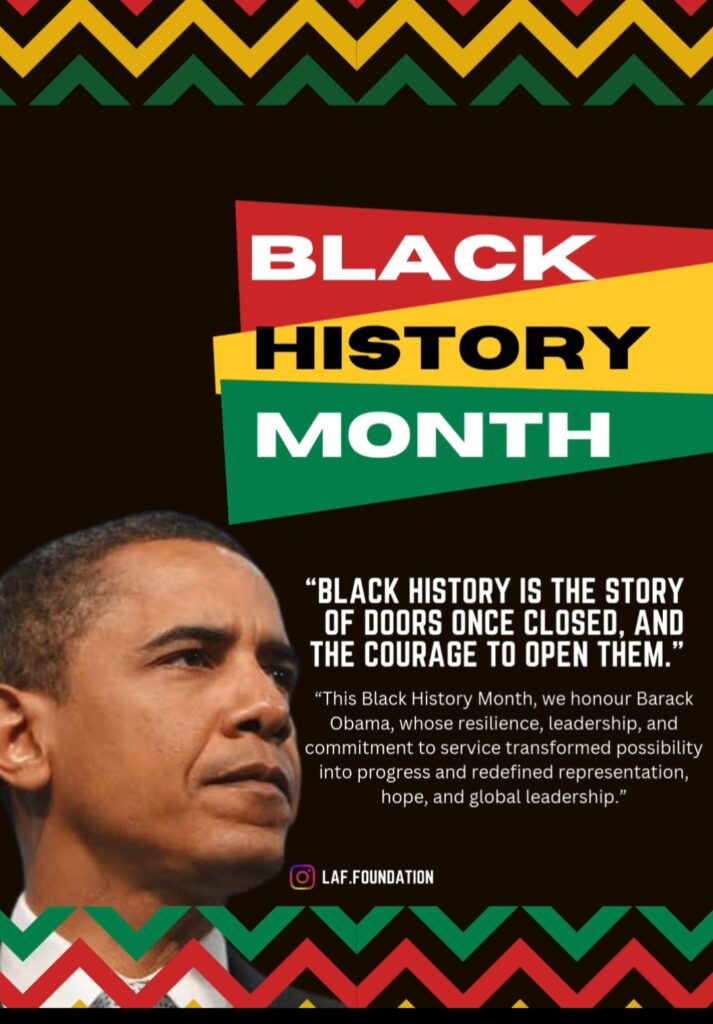
Black History Month offers an opportunity to reflect on individuals whose lives have reshaped narratives, challenged limitations, and expanded the boundaries of possibility. Among such figures stands Barack Hussein Obama, whose rise to the presidency of the United States marked a historic turning point not only for America, but for Black communities across the world.
Born in 1961 in Honolulu, Hawaii, Barack Obama’s background was far from the traditional image of political power. Raised largely by his grandparents and shaped by experiences across different cultures, Obama grew up with a strong awareness of identity, inequality, and responsibility. These early experiences would later influence his approach to leadership and public service.
Before entering national politics, Obama worked as a community organiser in Chicago, focusing on improving living conditions, employment opportunities, and social development in underserved neighbourhoods. This phase of his life grounded him in the realities faced by ordinary people and reinforced his belief that leadership begins with listening and service. He later became a civil rights lawyer and a lecturer in constitutional law, further deepening his understanding of justice, governance, and democracy.
Obama’s political journey gained momentum when he was elected to the U.S. Senate in 2004. His keynote address at the Democratic National Convention that same year captured global attention, offering a message centred on unity, responsibility, and shared progress. In 2009, he was inaugurated as the first Black President of the United States, a moment that symbolised the culmination of generations of struggle, advocacy, and perseverance.
While his presidency came with intense scrutiny and criticism, Obama remained committed to diplomacy, reform, and inclusive leadership. His tenure focused on expanding access to healthcare, promoting economic recovery, strengthening international relations, and advocating for equality. More importantly, his presence in the highest office of the land challenged long-standing perceptions about race, leadership, and representation.
For many Black youths around the world, Obama’s presidency became a powerful reminder that history does not define limits, it creates lessons. His journey illustrated that progress is not achieved overnight, but through discipline, resilience, and sustained effort. Obama did not present himself as flawless; instead, he embodied growth, accountability, and thoughtful leadership.
Beyond policy, Obama’s legacy lies in inspiration. His calm resolve in moments of crisis, emphasis on education, and respect for democratic values left a lasting imprint on global leadership discourse. He showed that strength can coexist with humility and that leadership can be exercised with dignity rather than dominance.
As Black History Month is observed, Barack Obama’s story serves as a testament to how perseverance can rewrite narratives once shaped by exclusion. His life affirms that representation matters, that service-driven leadership is powerful, and that hope remains a force capable of shaping history.
Barack Obama’s place in Black history is not defined solely by titles, but by the doors his journey helped open and the confidence it instilled in generations to come. His story continues to encourage individuals to lead with purpose, act with integrity, and believe in the possibility of progress.