

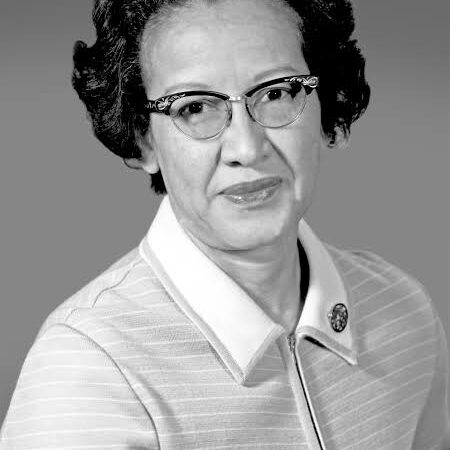
Katherine Johnson: The Black Mathematician Who Helped Send Humanity to the Moon
MoonBlack History Month is a time to recognize the individuals whose brilliance, resilience, and determination reshaped the world, often without immediate recognition. Among these pioneers stands Katherine Johnson, a mathematician whose calculations helped carry astronauts into space and safely return them home. Her story is one of intellect, perseverance, and the quiet strength that defines so much of Black history.
Born in 1918 in White Sulphur Springs, West Virginia, Katherine Johnson displayed extraordinary mathematical talent from an early age. At a time when educational opportunities for Black children were severely limited, her parents prioritized education and relocated so she and her siblings could attend high school. Johnson graduated from high school at just 14 and earned a college degree by 18 from West Virginia State College, a historically Black institution that nurtured her academic gifts.
Johnson began working at the National Advisory Committee for Aeronautics (NACA), which later became NASA, in 1953. She was part of a group of highly skilled Black female mathematicians often referred to as “human computers.” These women performed complex calculations by hand, determining flight trajectories, launch windows, and reentry paths. They worked in segregated offices and navigated racial and gender discrimination daily. Yet despite the barriers placed before them, their work was indispensable.
One of Katherine Johnson’s most significant contributions came during the early years of the U.S. space program. She calculated the trajectory for Alan Shepard’s 1961 spaceflight, making him the first American in space. Later, astronaut John Glenn specifically requested that Johnson verify the computer-generated calculations for his orbital mission around Earth. Glenn trusted her precision so deeply that he refused to fly until she confirmed the numbers. Her calculations were also essential to the success of the Apollo 11 mission, which placed humans on the moon in 1969.
Johnson’s achievements extended beyond technical skill. She challenged limitations simply by excelling in spaces where Black women were rarely acknowledged. In meetings dominated by men, she insisted on being included when her expertise was required. In environments shaped by segregation, she focused on excellence rather than exclusion. Her work demonstrated that Black brilliance was not an exception, it was foundational.
For decades, her contributions remained largely unknown to the broader public. It was not until later in her life that she received widespread recognition, including the Presidential Medal of Freedom in 2015. Her story gained global attention through the film Hidden Figures, which highlighted the overlooked role of Black women in NASA’s success. Yet recognition, while important, does not define her legacy. Her legacy lives in the precision of her work and the doors her success helped open for future generations.
During Black History Month, Katherine Johnson’s story reminds us that Black history is not only written in protest and politics but also in laboratories, classrooms, and control rooms. It is written in equations solved under pressure and in contributions that expanded humanity’s reach beyond Earth. Her life reflects intellectual courage, the kind that quietly dismantles barriers by proving them wrong.
Katherine Johnson represents a powerful truth: excellence is its own form of resistance. Through mathematics, discipline, and unwavering focus, she helped shape one of humanity’s greatest achievements. Her legacy continues to inspire young Black students, especially girls, to pursue science, technology, engineering, and mathematics without apology.
Black history lives not only in movements, but in minds that move the world forward. Katherine Johnson’s calculations carried astronauts to space, but her impact carries generations toward possibility.