

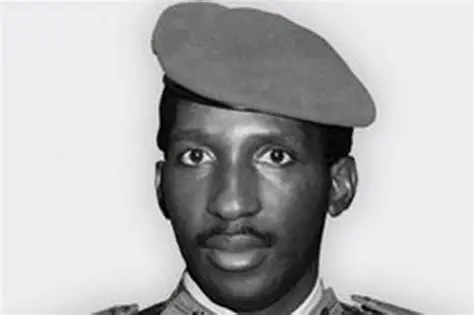
Thomas Sankara: The Revolutionary Who Reimagined African Leadership
Black History Month provides an opportunity to examine leaders who challenged not only colonial systems but also post-colonial complacency. Among the most compelling of these figures is Thomas Sankara, a military officer turned revolutionary president whose brief time in power reshaped political imagination across Africa.
Born in 1949 in Yako, in what was then Upper Volta (now Burkina Faso), Sankara came of age during a period when many African nations were newly independent yet still economically dependent. Though flags had changed and national anthems had been written, structures of exploitation often remained intact. Sankara believed political independence without economic sovereignty was incomplete.
In 1983, at just 33 years old, he became President of Upper Volta following a popular-backed revolution. Almost immediately, he signaled that leadership would not be symbolic. One of his first actions was renaming the country Burkina Faso, meaning “Land of Upright People.” The change was not cosmetic; it was a declaration of dignity and self-definition.
Sankara’s governance philosophy rejected luxury and elite privilege. He reduced the salaries of public officials, sold off the government’s fleet of expensive cars, and made the modest Renault 5 the official vehicle of ministers. He refused to allow personality cults, insisting that portraits of leaders should not dominate public buildings. For him, leadership was service, not spectacle.
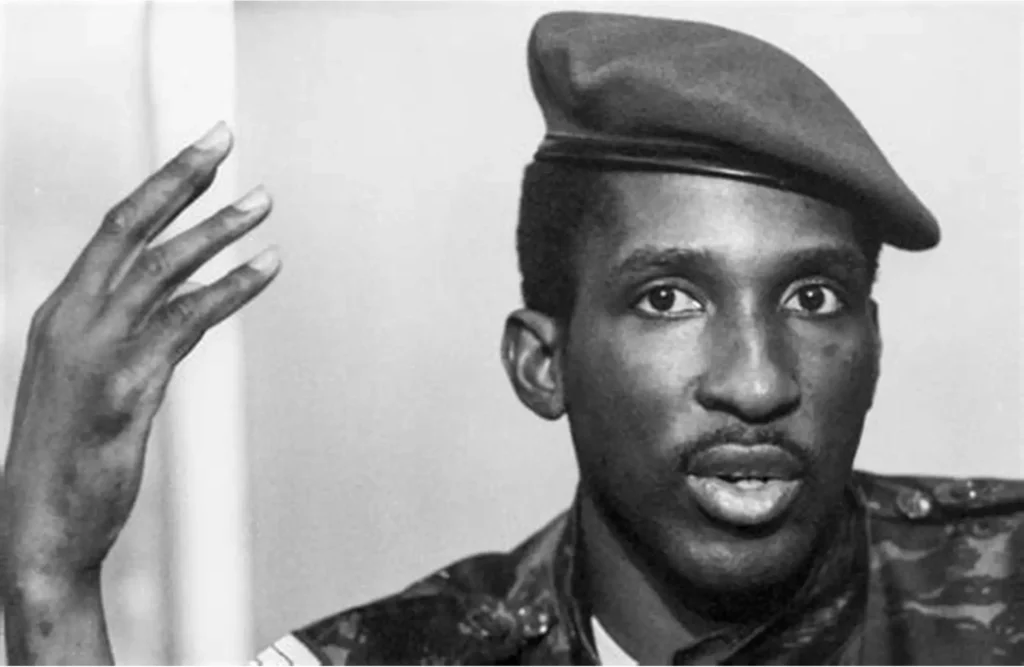
Economically, Sankara focused on self-reliance. He encouraged local agricultural production to reduce dependence on foreign aid and imported goods. Under his administration, Burkina Faso achieved significant increases in food production within a short period. He argued that aid often functioned as a tool of control, warning that “he who feeds you controls you.” His emphasis on domestic production and accountability challenged both Western economic influence and internal mismanagement.
Sankara also championed women’s rights in ways that were radical for his time. He appointed women to high governmental positions, outlawed forced marriage and female genital mutilation, and encouraged women’s economic participation. He viewed gender equality not as a secondary issue but as central to national development. A revolution that excluded women, he argued, could not be complete.
His environmental policies were similarly forward-thinking. Long before climate change became a global priority, Sankara launched massive tree-planting campaigns to combat desertification. He understood that environmental sustainability was tied to economic survival and long-term sovereignty.
On the international stage, Sankara was outspoken. He criticized neo-colonialism and called for African unity in confronting debt burdens imposed by global financial systems. At a 1987 summit of the Organization of African Unity, he urged African leaders to collectively refuse repayment of what he described as unjust debt. His speech remains one of the most quoted in discussions of economic independence and global power imbalance.
However, bold leadership often attracts opposition. In October 1987, Sankara was assassinated during a coup led by former ally Blaise Compaoré. His presidency lasted only four years, yet its impact far outlived his tenure.
Thomas Sankara’s legacy endures because he embodied alignment between rhetoric and action. He lived modestly, governed decisively, and articulated a vision of Africa grounded in integrity, accountability, and self-determination. While some of his policies remain debated, his insistence that African leadership must be ethical, disciplined, and independent continues to resonate.
This Black History Month, Sankara stands as a reminder that transformation requires courage. He did not merely critique systems; he attempted to rebuild them. His life challenges future generations to consider whether independence is simply political, or whether it must also be economic, cultural, and moral.